
Written by Christoffer Andreasson
Head of Content at Promote
A strong training session ends well. Participants are energized, the feedback forms are positive and the client says thank you. What happens in the following weeks often decides whether the work leads to the next engagement.
A short follow-up journey lets a training provider stay involved while participants apply what they learned, and gives clients a clear reason to keep working with that provider.
This article shows what such a journey looks like, how to plan one around a workshop you already deliver, and how to share progress with the client along the way.
The weeks after a session are where a guide helps most
In typical event-based training, only about 20% of participants find the moment to apply what they learned. The event delivers the knowledge and skills, and the search for the right moment to use them is left to each participant.
That search happens back at work, among routine demands and a full calendar. A participant may leave the workshop with a clear plan and still find the first real opportunity slipping past.
You are well placed to help. You know the content, you know the participants, and you know what good application looks like. The weeks after the workshop are a natural place to put that knowledge to work.
A follow-up journey extends the sessions and keeps it intact
Your workshop stays at the center. The methodology describes a journey that stretches across time, with the workshop as one part of it. Workshops in a journey are mostly used for practice, while theory can be handled in short, self-paced steps before and after.
The right length is as long as it takes participants to reach confident, independent performance. In one example from the methodology, a journey ran 30 weeks, and the participant was already applying her learning on the job within the first three.
A follow-up does not need to be that long. Here is a hypothetical example: a two-day workshop on coaching conversations is followed by six weeks of small, guided assignments. The workshop is unchanged. The six weeks are added around it.
Start with the moments where the skill has to show up
The methodology uses the term Moments-that-Matter for the on-the-job situations where improved performance makes the biggest difference. Naming them is the first design step for a follow-up.
Ask the client before the workshop where participants will use the skill: which meetings, which conversations, which tasks. Three to five moments are enough. For a coaching workshop, one might be the weekly one-on-one with a direct report.
Each participant then picks the moments with the highest leverage in their own role. The methodology calls this the Personal Performance Path. Everyone follows the same program, and each person focuses on the situations that matter most to them. It takes a short conversation with the participant, ideally with their manager present.
Each week asks for one small, real action
A follow-up journey works best when the weekly ask is small. Participants try something in real work, get feedback, reflect and adjust.
-
Try
-
Get feedback
-
Reflect
-
Adjust
Here is a hypothetical week-by-week plan for a coaching workshop:
-
Week 1: Choose one upcoming one-on-one and tell your manager which question you will try.
-
Week 2: Use the question in that conversation and write three lines on what happened.
-
Week 3: Share your notes with a peer and respond to one thing they tried.
-
Week 4: Try the question in a second, slightly harder conversation.
-
Week 5 & 6: Reflect on what has changed and choose one habit to keep.
The steps follow the Crawl, Walk, Run idea from the methodology. Early practice takes place where risk is low, and each new attempt moves closer to the real situation.
-
Crawl
-
Walk
-
Run
Job aids help along the way. A one-page checklist for a coaching conversation is a good example. Introduced during the workshop and used often afterward, it becomes a habit.
Managers open the doors to real opportunities
The methodology describes the manager's part as perhaps the most important way to strengthen the results of a journey. The manager identifies job opportunities where the participant can apply the new skill and gives ongoing coaching and feedback.
You do not need to train every manager. You can make the role easy. Send each manager a short note: what their team member is practicing this week, and one question to ask in the next one-on-one.
A hypothetical note might read: "This week Sara is trying a new opening question in her team meeting. You could ask her afterward what she noticed." That takes a minute to read, and it tells the participant that someone expects the skill to be used.
Clients see progress while it happens
The methodology describes impact as a partnership among L&D, participants, managers and senior leaders. Each group has a role, and results grow when each group sees its part.
A follow-up journey gives you something to share with each group while the program runs. Participants can see their own progress. Managers can see what their people are practicing. The client's L&D contact can see how many participants have tried the skill in real work, and what they learned.
Good evidence can be simple: a few short examples of what participants tried and what happened. You can add a brief summary for the client's senior leaders.
A platform makes it possible to run many journeys at once
Running a follow-up for one cohort is manageable by email. Running it for several cohorts and clients at the same time takes structure.
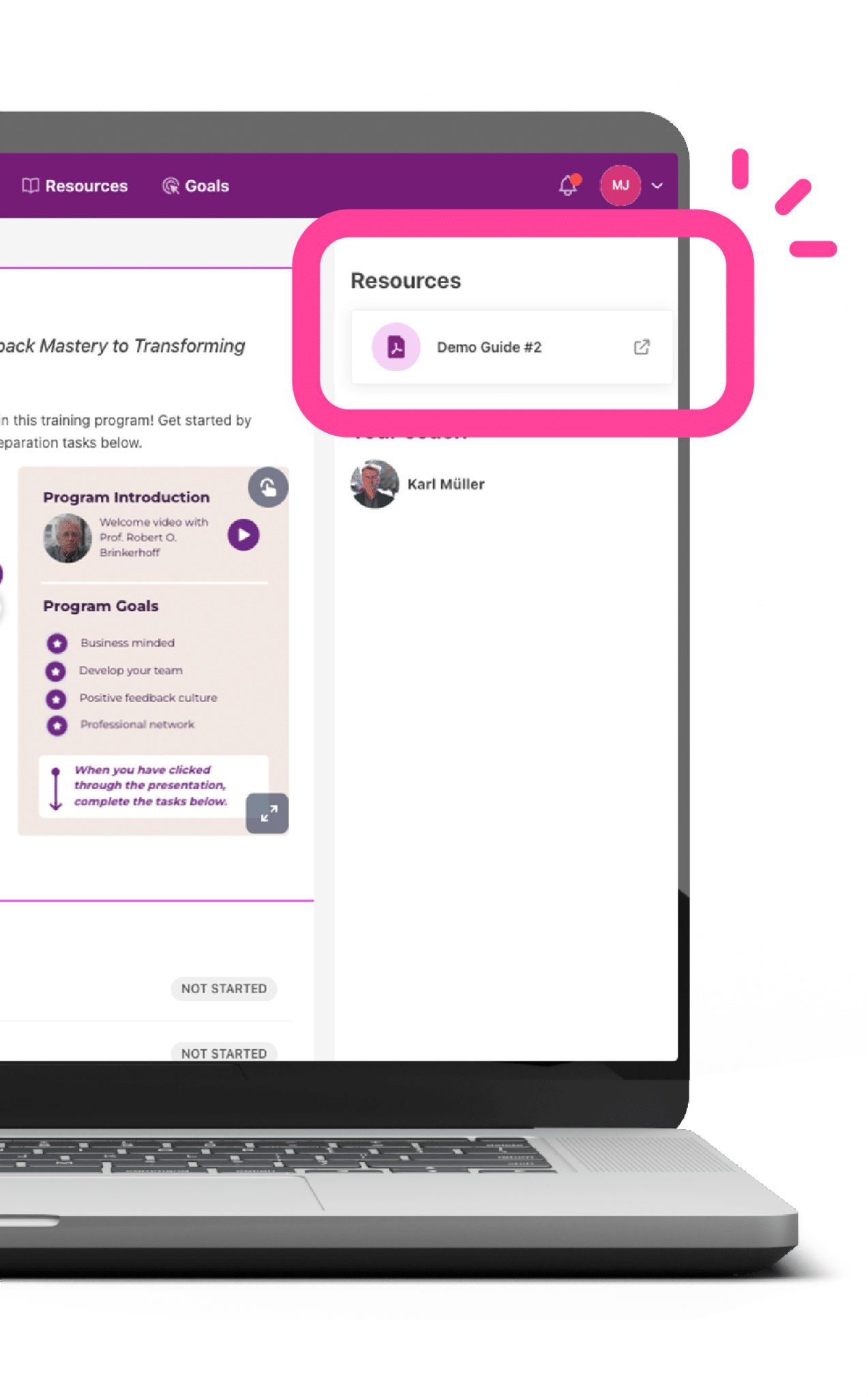
Promote is built for this. Journeys are laid out over time, with application-based tasks, reflection and peer feedback built in. Facilitators can stay in contact with participants, and enrollment and tracking run in one place. A provider can turn a time-limited classroom training into a full learning journey with practical application and measurement, and reach a larger audience with it.
A learning management system (LMS) continues to do what it does well as the system of record for enrollment and content. A learning journey platform works as the system of action for what happens after the workshop. The two complement each other.
Where could one small follow-up begin?
Pick one workshop you deliver often. Name the three moments where participants need to use the skill, and write down one small action for each of the next four weeks.
That outline is the start of a follow-up journey, and you can test it with your next cohort. When participants have something to try, someone to ask and a way to share what happened, the workshop becomes the first step in a longer conversation with the client.
Which session in your portfolio would benefit most from four more weeks of support?
-
Blog
Insight type
-
Automated follow-up
Category
-
Method
Topic