
Written by Christoffer Andreasson
Head of Content at Promote
Good measurement starts with one question: what will we do with this data? When the answer is clear, the right numbers become easy to choose.
Promote is built on the High Performance Learning Journey (HPLJ) methodology, developed by Dr. Robert O. Brinkerhoff and Edward Boon. In HPLJ, measurement is part of the journey itself. Completion and satisfaction data stay useful, and alongside them a learning journey can show what people apply at work and what that does for the business.
Measurement works best when it starts with a purpose and follows the journey from the first session to the business result.
It starts with why, before how
There are hundreds of things an L&D team can measure: reactions, knowledge gains, attendance, completion, retention, on-the-job application. The authors of the HPLJ methodology suggest choosing among them by purpose first. Every measure should serve a decision someone needs to make. The methodology groups evaluation purposes into three:
-
Steer
-
Gauge impact
-
Strengthen future investments
Steering uses data while the journey is running, to keep it on track. Gauging impact looks at what the program achieved. Strengthening future investments uses what was learned to make the next program better and to show stakeholders what helps learning pay off.
Measurement takes time and energy that could also go into supporting performance, so each measure should earn its place. A good test is to ask who needs the data, what they will do with it and whether the effort is worth it.
Most programs need only a few purposes. A small pilot with 20 sales managers needs fewer methods than a program across several countries.
Early data keeps the journey on track
Because a learning journey runs over weeks or months, there is time to act on what the data shows. Useful signals early on include assignment completion and engagement rates, the share of managers who have reinforced the participants' learning, and short participant check-ins on commitment and on obstacles they meet.
Each signal points to an action. If an assignment is too heavy, the volume can change. If a participant is slowing down, a facilitator can step in. If managers need a nudge, they can be prompted at the right moment.
Application can be tracked in stages
"Did people apply it?" is easier to answer when application has levels. The HPLJ methodology builds them gradually, in three stages: Crawl-Walk-Run.
-
Crawl: noticing, assessing, trying out
-
Walk: applying consistently in the Moments-that-Matter
-
Run: instructing others, leading change, advancing the practice
This gives L&D teams a shared language. A participant who has started noticing the behavior in colleagues has made progress. A participant who tries it in a low-risk setting and asks for feedback has made more. Across a cohort, the picture shows how far the group has come and where support is needed.
A typical HPLJ aims for all participants to apply the content consistently and effectively in their work. Reaching the Run stage is a welcome bonus beyond that goal.
A good evaluation plan is useful, believable, and practical
The methodology offers five criteria for a sound plan. Validity and reliability are the technical basics. Three strategic criteria shape the plan:
-
Actionability
The more a finding can be used, the more it is worth. Findings also need to arrive in time to matter.
-
Credibility
Decision makers need to trust the data. A good first step is to ask them early what evidence they would find convincing. Using more than one perspective, such as participants, their managers and business data, makes evidence stronger.
-
Practicality
Data should be good enough for its purpose. Existing records, such as assignment completion, are a good place to start before adding a survey.
The three work together. Raising one can lower another, so the goal is balance.
Stories and numbers work best together
Numbers show scale. Stories show what the change looked like in someone's day. The methodology recommends combining them: program statistics, quality of participants' work and action reports, manager views of improved proficiency in the Moments-that-Matter, and interviews that collect success stories.
Evidence is also more convincing when more than one voice supports it. A participant describes a new approach, the manager confirms it, and a business measure moves in the same direction. That is the kind of evidence a senior leader can act on.
Measurement also helps everyone see their part. The authors point out that impact from training is a partnership between L&D, participants, their managers and senior leaders. Clear evidence of what works, such as how manager support relates to results, helps each group take its role with confidence.
A simple plan fits on one page
Here is a hypothetical example. A company runs a leadership journey for first-line managers and wants to know whether the new coaching conversations are happening.
-
Week 2
-
Week 6
-
Week 12
At week 2, the team checks assignment completion and whether managers have approved participants' Personal Performance Paths, and asks participants what is getting in their way.
At week 6, participants report where they have tried the new approach, and their managers confirm what they have seen.
At week 12, a few short interviews collect examples of what changed and a business measure the sponsor already tracks is reviewed.
Each step has a purpose, an owner and an action it can lead to. Nothing is collected without a use for it.
Promote makes application visible
An LMS is a system of record. It reliably shows who enrolled and who completed. A learning journey platform is a system of action. It supports what happens next, and records it. The two complement each other, and together they give a fuller picture.
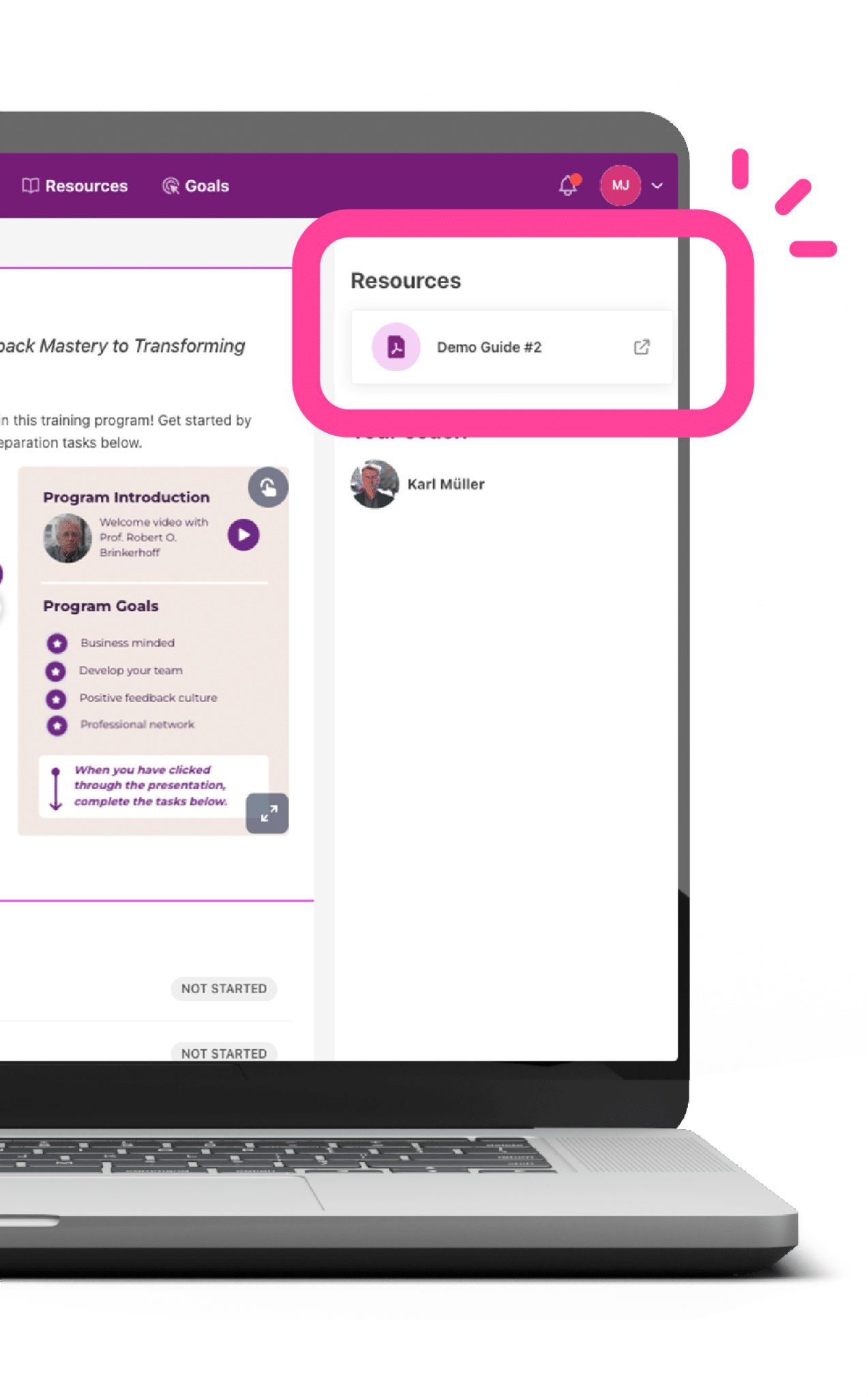
A digital platform keeps an automatically updated record of assignments, participant actions and manager actions, which makes many measurement tasks much easier. Promote is built for this. Managers and leaders can follow participation, progress and application in one place, and use it to steer the journey while it runs.
Promote also supports teams with a Measurement and Optimization service. It helps design an evaluation plan, analyze engagement and impact data, identify and manage performance barriers, fine-tune the journey, and communicate the impact story to stakeholders.
One question to start with
Before your next program launches, ask your stakeholder: what would you want to see after six weeks to know that it is working?
The answer tells you what to measure, who needs the data and what action it should lead to. It also gives your sponsor a role in the plan from the start, which makes the evidence easier to trust when it arrives. It is a good first step toward a measurement plan that people use.
-
Blog
Insight type
-
Platform
Category
-
Method
Topic