

Picture of Written by Christoffer Andreasson

Written by Christoffer Andreasson

Head of Content at Promote

Most organizations know how to deliver training. The harder part is what happens afterward: whether people use what they learned, in the situations where it matters, and whether it makes a difference to the business.

Promote is built around a method designed for exactly that. It's called the High Performance Learning Journey (HPLJ), developed by Dr. Robert O. Brinkerhoff and Edward Boon, and refined over 40 years of research into what makes training work.

The idea is simple: learning turns into performance when the time after the session is designed, not left to chance.

Here's how it works.

It starts from what's possible, not what's typical

In typical event-based training, only about 20% of participants find the moment where what they learned meets a job situation where it makes a real difference. The rest simply never encounter that intersection. They return to full inboxes, the next project and a manager who may not know what the training was about.

That isn't a motivation problem. When a program ends with the event, application is unplanned and unsupported. The HPLJ method turns this around: most of the journey takes place after the first session, and the design is built around helping each participant find those moments.

It treats the journey as a series of short steps, not one big event

An HPLJ is a sequence of short learning modules, spread over time. Participants build the knowledge they need and then go through several rounds of practice with feedback, until they can apply the skill independently on the job.

The balance is what sets it apart. Most of the time is allocated to practice and application. Only as much as necessary is allocated to theory. Every journey follows the same four steps, and participants return to them as they progress:

  • Commit
  • Build the knowledge foundation
  • Develop and practice skills
  • Strengthen results
  • Commit to the journey

    Participants, their managers and their peers understand what's in it for them and agree to take part. Commitment is renewed along the way, especially when the journey gets tough.

  • Build the knowledge foundation

    Everyone gets the same core concepts and language, in short formats that fit into the workday.

  • Develop and practice skills

    Structured practice activities, specific feedback and time to reflect.

  • Strengthen results

    Practice moves closer to real work, until participants apply their new skills where it matters most.

It stretches learning across five dimensions

Spreading learning over time is a good start, but time is only one dimension. A true HPLJ is stretched across five:

  • Time

    Time: Learning is paced over weeks or months, and participants begin applying it within the first weeks.

  • Spaces

    Learning happens in the classroom, online, on the job and in conversations with colleagues, wherever it is most powerful and convenient.

  • Relationships

    Managers, facilitators, peers, coaches and even customers all have a role in feedback and support.

  • Tools and structure

    Checklists, job aids and guided activities turn good intentions into concrete practice.

  • Business linkage

    Every activity connects to a result the organization cares about. The authors call this the most powerful dimension of all.

It builds skills in stages: crawl, walk, run

Complex skills aren't learned in a single step. The HPLJ method builds them gradually, in three stages.

  • Crawl
  • Walk
  • Run

Participants first learn the basics and try them in a safe, low-risk setting. They then practice in more realistic scenarios, such as role-plays. Finally they apply the skill in the real situations where it counts, with support from their manager and feedback from others.

Each stage builds confidence for the next, and each starts from where the participant is today.

It gives everyone a clear line of sight

Every journey starts with a one-page map called the Program Performance Path. It connects four things:

  • Learning outcomes
  • Moments-that-Matter
  • Performance outcomes
  • Business rationale

It answers who the participants are, what they'll learn, where they'll use it and why it matters to the organization. That's what lets a senior leader see the logic of the investment at a glance, and what lets participants see beyond the classroom.

Each participant then creates a Personal Performance Path. Two people can go through the same program and focus on different Moments-that-Matter, depending on their role and where they most need to improve. The result is a program that feels relevant to each person without a separate course for everyone.

It makes managers part of the journey

In Brinkerhoff's research, manager engagement often had more to do with results than what happened during the learning event itself. When participants know that their manager cares, expects results and will support them, the odds of impact increase dramatically.

In an HPLJ, the manager's role is built into the design: discussing goals with the participant before the journey, giving feedback along the way, and creating opportunities to apply new skills afterward. They don't become the trainer. They become part of the mechanism that turns training into changed behavior.

It makes application visible and measurable

What gets expected and followed up gets done. In a well-run HPLJ, there is a clear record of who is applying what, how managers are taking part, and how far each participant has come. That gives learning teams something they rarely have: evidence of what happens after the training, not just who attended.

How Promote makes it practical

An HPLJ takes coordination: reminders, assignments, feedback loops, manager check-ins and a way to follow progress. Done manually, it's hard to run at scale. Promote is the platform built to deliver this method, so journeys can run smoothly for ten participants or ten thousand.
Journeys are planned over time and participants are guided step by step. Managers and coaches are prompted at the right moments, and application is tracked all the way to results. People stay at the center, as facilitators, coaches and managers. Promote makes their time count.

The method was there first, and the platform followed. That's why Promote works the way it does.

Congrats, Almost there!

A few things to consider before trying the platform:

And to make it as easy as possible...

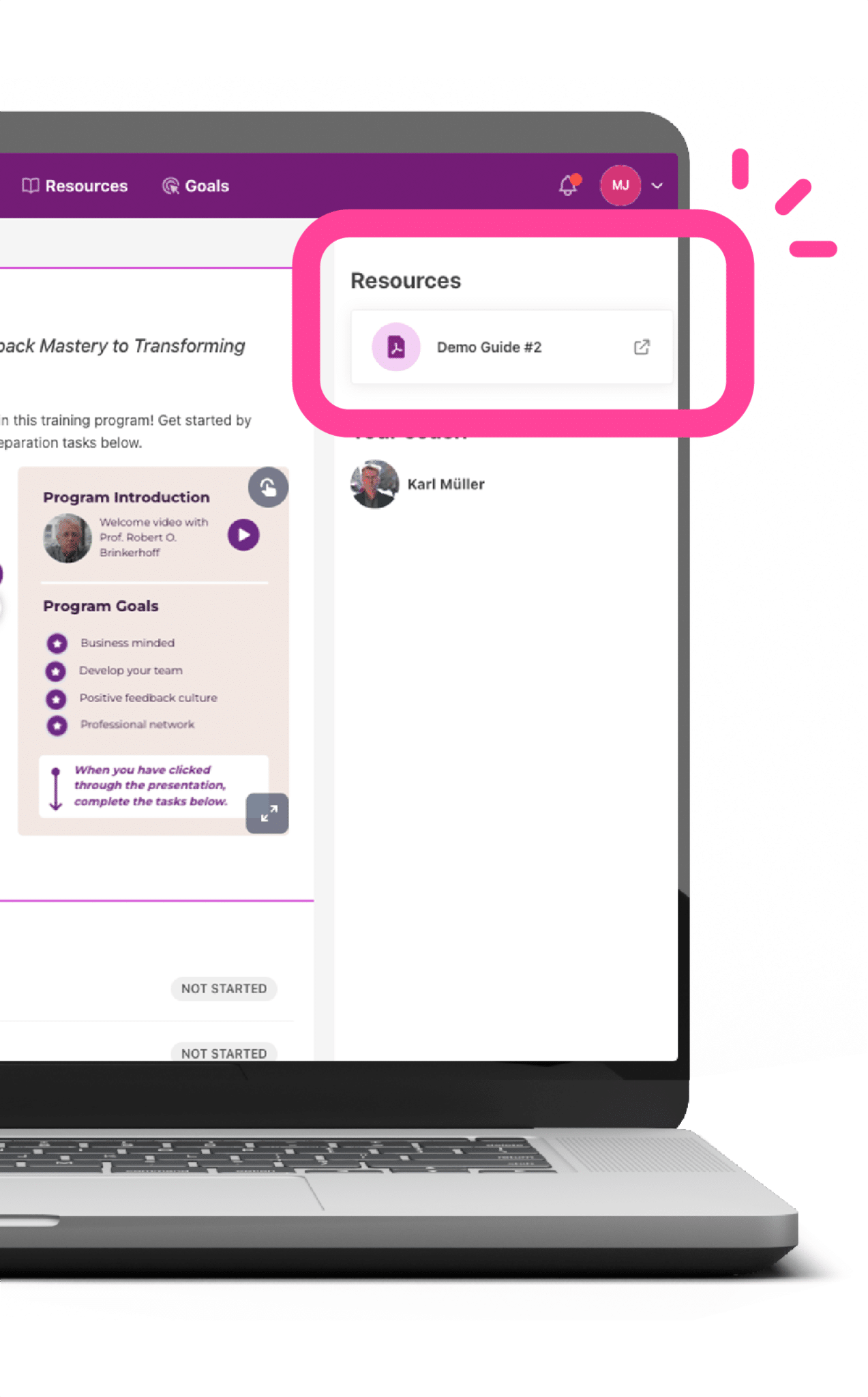
…there’s a Demo guide within each module, explaining all the nifty features of the Promote Platform! You can find it under resources on the right hand side of the screen.